In my previous story about energy, I briefly touched on housing, because obviously it overlaps with energy in terms of solar roofs; and in terms of efficiency standards for heating and cooling etc. But now I’m going to go more in-depth on the type of housing policy I’d be pursuing. Obviously, this is extremely to the left of the UK establishment, and I’d probably get locked up at this point in authoritarian Britain if they find my blog. I think I’m joking about that anyway…
Ban landlords (and second homes)
The first and most urgent step the country desperately needs in my opinion is to ban private landlords. The rent is insanely high in the country and bears almost no relation to the wages working class people are earning. We need to get rid of private renting as a category. It’s not acceptable for rich people to be able to buy more than one home, and get their tenants to effectively pay the landord’s mortgage for them. It’s a disgusting practice and needs to end. The only renting that should be going on in the country (and world) is social renting.
We must force all landlords to sell their properties to councils. My instinct would be to force them to do it for below market rate (for the first rental property where they’re not the owner-occupier). But perhaps we could have a sort of “housing amnesty”; during which time, landlords could come forward, and get a better deal or some other benefit. This would be for the first property though (and apply to all second / holiday homes as well). For any additional properties, councils would just seize them. I don’t think landlords deserve to get paid back for all the properties, considering all the rent that they’ve effectively stolen from their tenants over the years. The value of one property would be more than generous in my view.
Nationalise the house builders
Every time I see a story in the local news about a new proposed development; or even “sustainable” communities from centrist outlets like Everything Electric (formerly Fully Charged), I’m almost never impressed. Most of the time, I’m dismayed at the idiotic designs of the average new build estate. The homes are all unsustainable, old fashioned and car-dependent. Worst of all, they’re totally unaffordable for the vast majority of people.
Some supposedly sustainable developments I’ve seen are still car-dependent; consisting of detached and semi-detached housing, with garages and built-in EV charging. Yes, that sounds good to most people on paper these days. But it’s really not and here’s why. It’s firstly not affordable, and creating new car-dependence at this point is insane. We need to be moving away from car ownership, EV or otherwise. The vast majority of these developments or new towns don’t have well thought through public transport plans. They’re often not built around a train station. The bus routes don’t exist or the service is poor. There’s usually no cycling infrastructure provision, and if there is, it’s patheticlly poor. You need centralised government planning to make sure this stuff is done well. And you need experts on sustainability, local ecosystems, public transport and active travel involved at every stage of the process. Ideally leading the process rather than just consulting. As far as I can tell, these things are practically never properly considered. The only development I can think of that did a decent job is Eddington, near Cambridge. And that is led I believe by Cambridge University, so you’d expect some smart planning there.
These bad decisions are hard to fix once the houses have been built. It locks in incoherent design in the country for decades to come, which will make things so much harder for future governments than they need to be. Especially when they’ll be desperately trying to reduce emissions and car dependence by then.
We also need to move away from large, detached houses. And not just because they’re expensive. They’re also very space inefficient obviously. We need to be building density. I’m lucky enough to have grown up in a detached home. Since 3 or 4 years old anyway. I can’t remember before that when apparently we lived in a semi-detached. If everyone in the country lived in a detached house, we’d run out of room. It’s an inherently unfair form of housing if you want an equal society. There are benefits of detached houses though. There’s no doubt about that. Certainly the biggest for me is having a garden. You have the ability to make your own space a haven for nature, which I really appreciate. The other benefit I feel in my own life is the ability to play music out loud without annoying your neighbours. The biggest benefit for most people would probably be having freehold over the land. Avoiding leasehold ownership of flats is definitely a huge plus. But I think these are all things that can apply in apartment buildings if we choose to make that change.
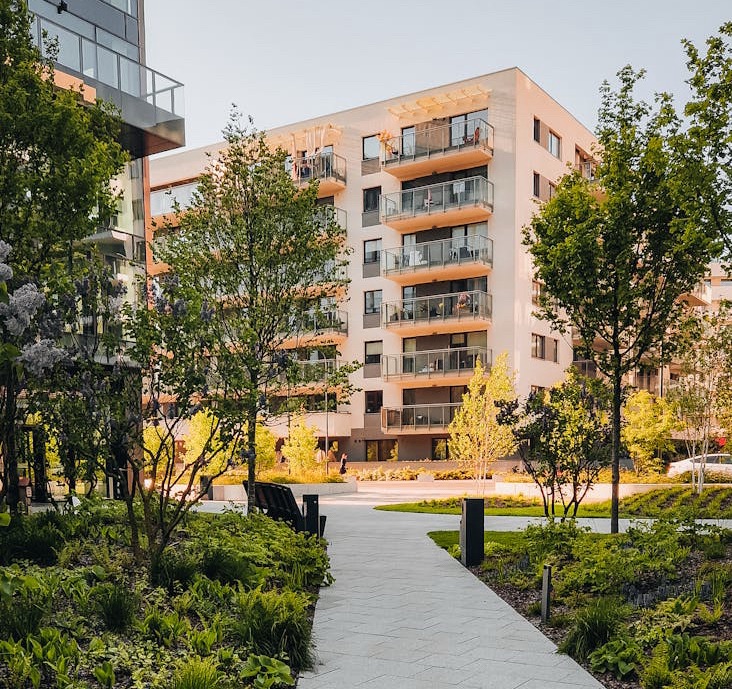
As I wrote in my last article, we can build apartment buildings and terrace housing in harmony with nature. Without fences, with wild areas and generally an open feel that’s good for people and wildlife. Yes, we hear on Springwatch how “wildlife corridors” (aka making a hole in your fence) can help massively, and that’s true as long as you have nice neighbours who want to join you. But we can do so much better.
We can also design high quality apartment buildings that have good sound insulation, allowing people to not disrupt their neighbours (or as much as possible). With regard to leasehold properties; it’s slightly more difficult. When you have council housing as a major part of the housing stock, you clearly don’t have that problem. But in terms of ownership, we can mandate collective freehold among the owners of the flats in a building. It’s never going to be the same as true freehold for apartment dwellers; but as long as we make sure the occupiers own the building and not a company or the original developers, then that’s a decent compromise.
Even though I’ve personally never lived in a flat, I’ve always been fascinated by them. I used to enjoy going to visit my Grandparents who lived in a block of flats in the town centre when they downsized from the former family home. I thought it was so cool. The layout, the communal areas (even though there wasn’t much to speak of at that place), the intercom and remote front door unlocking. Even the underground car-park interested me. I guess you’re always going to be curious about a different way of living than what you’ve been used to your whole life. But it’s more than that. I’ve always been interested in small spaces. When I was young, I made a little clubhouse in a cupboard in one of the bedrooms. Aside from my own interests, I do believe that it’s the best and most sustainable way for all of us to live; and we can do some really innovative things to improve our quality of life that we haven’t really considered up until now. Well, except the rich. Funnily enough, the rich individualistic capitalists have the best communal facilities out there in their fancy apartment buildings or at luxury hotels they frequent around thr world. It’s time for everyone else to experience a bit of luxurious convenience in our lives too.
Going back to cost; the reason why these developments overwhelmingly consist of detached and semi-detached houses is because these privately owned developers make more profit from that type of housing. Even the apartment buildings that are built are almost exclusively luxury ones. It’s no great secret.
The only way to get affordable housing built is to nationalise the developers and bring in strict, expert led, ecologically considerate building regulations. That way, we can ensure that we’re building future-proof housing and infrastructure. Far from what we’re building right now, which is not fit for this century, and barely fit for the last one.
Build a lot of council housing
We have a housing crisis. We need to build a lot of housing. But we have to be intelligent about how we do it and where. I don’t think we should necessarily close the door on home ownership. At least not straight away. That’s for the long term degrowth communist plan. But for the moment, I’d like to see full focus on small, affordable, but still quality made council homes; with a small percentage of homes to buy. We have a lot of brownfield sites in this country we can be building on. According to the government, there are enough brownfield sites to build 1.5 million homes, and that half of these sites could be built on immediately. And not only that, I think it would be reasonable to assume that this figure of 1.5 million homes probably includes a lot of detached and semi-detached housing. So logically, you could build a lot more than that if you focused entirely on flats and terrace houses. And that’s building mid-rise buildings. No massive Hong-Kong style residential towers required. We should start there, and only go further out into the countryside when we’ve exhausted all other avenues.
I say start with brownfield sites, but actually, we have a lot of empty homes in this country too (around 700,000!). And when you combine those with all of the former private lets that we’d be taking into council control, we’d be able to make a big dent into our housing problems very quickly. According to the Office for National Statistics, 19% of all UK households in 2024 were in the private rented sector. It has overtaken social renting at 17%, with owner occupiers at 65%. We should be aiming to eliminate private rentals within a few years, and increase the social rented sector to something like 50% in the same kind of timeframe.
I think it’s definitely possible if we try. That’s fundamentally what’s holding us back. The only thing the neoliberal governments of recent times have been trying to do is increase house prices to encourage selfish homeowners to vote for them at the next election.


